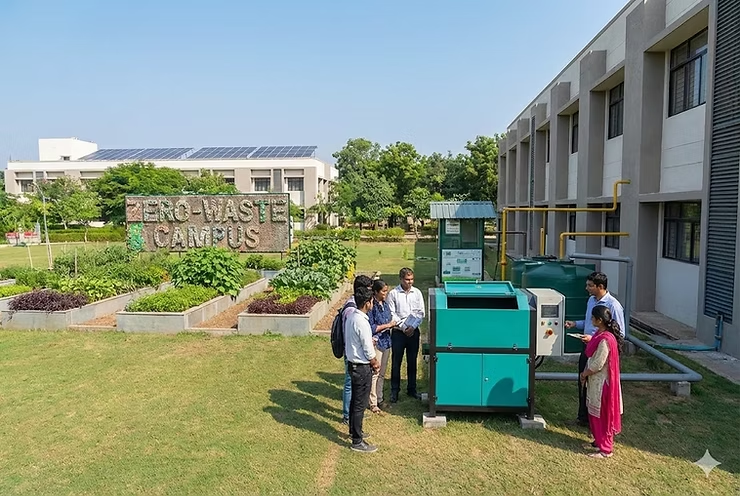
India’s educational sector is evolving rapidly. Schools, colleges, universities, hostels, and residential campuses now recognize their responsibility toward sustainability, biodiversity, and waste reduction. A zero-waste campus is no longer just an environmental goal—it is a practical, achievable system that creates cleaner surroundings, reduces waste-disposal costs, and teaches students lifelong eco-values.
A major part of campus waste comes from:
- Canteens & hostels (food & organic waste)
- Gardens & landscaping (leaf waste)
- Classrooms & offices (paper, packaging)
- Laboratories & workshops (select biodegradable waste)
To manage this effectively, institutions across India are adopting campus-based composting machines and biogas plants—the two core components of an efficient school waste management system.
Samkiti Environment and Engineering Solutions, a leading provider of composting machines and bio-methanation systems across India, is helping institutions transform their waste into valuable resources.
Let’s explore how.
Why Schools & Colleges Need a Zero-Waste Waste Management System
1. Environmental Responsibility
Institutions shape the future. Introducing students to sustainability helps them develop environmentally conscious habits early.
2. Financial Savings
Waste disposal is expensive. Composting and biogas plants reduce transportation, landfill, and waste collection costs.
3. CSR & Accreditation Benefits
Boards and accreditation bodies increasingly reward eco-friendly practices under:
- NAAC accreditation
- CBSE/ICSE green campus evaluation
- Swachh Bharat initiatives
- Green School Program (CSE)
4. Energy & Resource Conservation
Biogas generated from food waste reduces LPG usage in hostels and canteens.
5. On-Campus Learning Laboratory
Students learn about:
- Circular economy
- Microbiology
- Renewable energy
- Environmental science
- Waste segregation
Practical learning becomes more powerful than theory.
Types of Waste Educational Institutions Generate
Schools and colleges typically generate the following types of waste:
| Waste Type | Examples | Suitable Solution |
|---|---|---|
| Organic Waste | Food waste, vegetable peels, leftovers | Composting Machine / Biogas Plant |
| Garden Waste | Leaves, branches, grass clippings | Shredding + Composting |
| Paper Waste | Notebooks, exam papers, cartons | Recycling |
| Biodegradable Waste | Tissue, cardboard, biodegradable cutlery | Composting |
| Sanitary Waste | Washrooms, staff rooms | Separate disposal |
This variety makes a structured waste management system essential.
How Composting Machines Help Create a Zero-Waste Campus
A composting machine converts organic waste into nutrient-rich compost in 24–48 hours. This is ideal for:
- Hostels
- Canteens
- Staff quarters
- School kitchens
- College mess
- Cafeterias
How it Works
- Organic waste is collected (food, kitchen waste).
- Waste is shredded for faster microbial action.
- Composting machine mixes, heats, and processes the waste.
- Within 24 hours, ready-to-use compost is produced.
Benefits for Institutions
- No smell, no pests, no manual handling.
- Reduces waste disposal cost.
- Ideal for gardens & landscaping.
- Demonstrates environmental stewardship.
- Requires minimal operational training.
Samkiti’s automatic composting machines are specially designed for educational environments—low noise, low maintenance, and high efficiency.
How Biogas Plants Help Schools & Colleges Save Energy
Biogas plants convert food waste into clean, renewable energy—perfect for:
- Hostel kitchens
- College canteens
- Residential campus dining halls
Process Overview
- Leftovers & food waste enter the digester.
- Anaerobic microbes break down organic matter.
- Methane gas is produced.
- Gas is piped directly to kitchens for cooking.
- By-product slurry becomes organic fertilizer.
Benefits
- Cuts LPG cylinders usage.
- Provides renewable energy.
- Reduces cost of waste transportation.
- Produces valuable fertilizer.
- Minimum operating cost.
Samkiti’s bio-methanation systems are engineered for safety, durability, and high gas output.
What a School Waste Management System Looks Like (Step-by-Step)
- Waste Segregation at Source – Bins for wet waste, dry waste, and recyclables.
- Collection & Transport – Training housekeeping staff to follow structured waste routes.
- Shredding & Pre-Processing – Shredders reduce waste volume, enabling faster composting.
- Composting or Biogas Processing – Using Samkiti’s automatic composting machine or biogas plant.
- Utilization of Output – Compost for campus gardening, biogas for kitchens, slurry as fertilizer.
- Reporting & Student Engagement – Displaying data on waste processed, energy saved, and carbon emissions reduced.
Who Should Install Composting & Biogas Plants?
Ideal for:
- Schools with more than 500 students
- Colleges & universities
- Hostels & residential campuses
- Technical institutions
- Agriculture & environmental science colleges
- Convent schools
- International schools
- CBSE/ICSE schools
- Municipal schools
Cost Savings for Institutions
Composting Machine Savings
- Saves 30–50% on waste disposal costs.
- Reduces garden fertilizer expenses by 70–100%.
- Faster ROI (1–3 years).
Biogas Plant Savings
- Reduces LPG usage by 30–60%.
- Low maintenance.
- Long-term energy sustainability.
Educational institutions often recover their investment quickly.
Why Samkiti Environment and Engineering Solutions Is the Best Partner
- Specialization in Institutional Waste Management – Solutions designed specifically for schools, colleges, and universities.
- Wide Range of Composting Machines (10 kg/day to 2 ton/day) – Covers all sizes, from small schools to large residential campuses.
- High-Efficiency Bio-Methanation Plants – Built to ensure maximum gas output from food waste.
- Engineering Expertise – Composting machines, biogas plants, shredders, material handling conveyors, waste processing systems, and generator sets with acoustic enclosures.
- PAN India Delivery & Installation – Serving Maharashtra, Karnataka, Gujarat, Delhi NCR, Tamil Nadu, Kerala, Telangana, and all major Indian cities.
- Low Maintenance & Long Life Equipment – Institution-friendly design with minimal operational training.
- Strong After-Sales Support – Maintenance, AMC, operator training, and remote diagnosis.
- Better Quality Than Competitors – Superior engineering, durability, safety, and efficiency compared to generic suppliers and local vendors.
Ready to Transform Your School or College into a Zero-Waste, Eco-Friendly Campus?
Contact Samkiti Environment and Engineering Solutions for:
- Composting machines
- Biogas plants
- Waste processing systems
- End-to-end campus waste management
Book a Consultation | Get a Quote